
You Must Be a Subscriber to View This Page
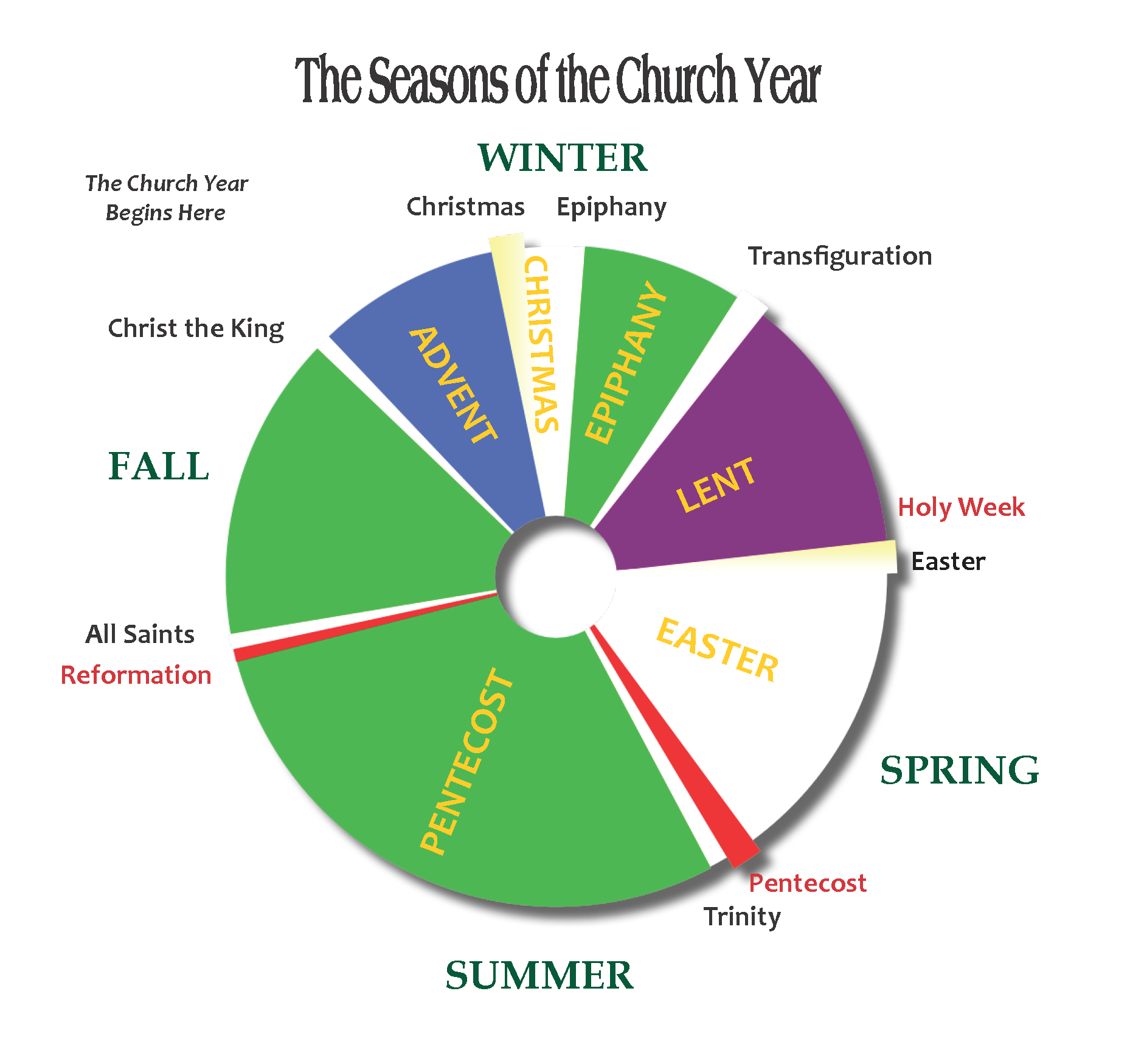
Seasonal Pages
Upcoming Services
Nov 1, 2026 - All Saints Sunday
Nov 22, 2026 - Christ the King
Jan 6, 2027 - Epiphany of Our Lord
Jan 10, 2027 - Baptism of Our Lord
Annual Festival Days
Specific Dates in the Church Year
During the Church year there are days that the Church marks to recall special events, as well as the historical saints who have faithfully served the Kingdom of God in their lives. Among those days are are the days of the 12 disciples, the apostles of the early church, and specific moments in the life of Christ (or the time leading up to his birth).
DOC File: List of Lesser Festivals PDF: List of Lesser Festivals
Observing these dates is by no means mandatory for a parish, but it can be a way of teaching today's disciples about those who faithfully followed God in the past. We can draw strength and courage from the cloud of witnesses by remembering them throughout the year.
Prayers of the Day for Worship
This list of collects is based on the Augsburg version of the RCL, written by Pastor Mark Anderson and produced by our freinds at Luther House of Study, Sioux Falls, SD and made available freely for use by congregations.
List of Traditional Church Festivals by Month
(The prayers in red below were written by the Rev. Cathy Ammlung, NALC)
January
January 1: The Name of Jesus
The prophets foretold the coming of the Messiah into the world, and when they did they gave him myriad names: Wonderful Counselor, Mighty God, Everlasting Father, Prince of Peace (Isaiah 9:6), but also Immanuel (Isaiah 7:14). In Matthew’s Gospel, an angel came to Joseph to explain to him the holy situation that his betrothed, Mary, was in (Matthew 1:18-25). Joseph was told what the name of the newborn should be: Jesus, for he will save his people from their sins. All of this came to pass when Mary and Joseph fulfilled their religious duty by taking Baby Jesus to the temple on the eighth day of his life.
Bible Readings:
Numbers 6:22-27; Psalm 8:1-9; Galatians 3:23-29; Luke 2:21
Thank you, Jesus, for taking on our human nature and submitting yourself to your own Law. Thank you for shedding your blood, even as a tiny child, for our sake. Thank you that you do the very thing your name announces: you save your people from their sin.
January 18: The Confession of St. Peter (Week of Prayer for Christian Unity)
The confession of St. Peter that Jesus is the Christ appears in all three of the synoptic Gospels. This confession is the foundation of the Christian faith and the true measure of orthodox theology. “Who do you say that I am?” is a fundamental question for every person who claims to be a Christian. To follow Christ is to confess, “You are the Messiah, the Son of God.”
Bible Readings:
Acts 4:8-13; Psalm 18:1-7, 17-20; 2 Peter 1:1-15; Mark 8:27-35 (36 — 9:1)
January 24: St. Timothy
Timothy was Paul’s young friend and coworker. His name means “honoring God.” Paul referred to the young man as “my true child in the faith” (1 Timothy 1:2). We hear of his faith from Paul, who pays respect to Timothy’s mother and grandmother, who instilled in him the faith. Timothy was highly regarded by the believers in Lystra for his faithful work (Acts 16:1-2). He accompanied Paul on some of his journeys but was also sent out by the apostle when Paul could not travel. In those cases, Timothy himself took the message of Christ to the people and preached the Good News of salvation.
Bible Readings:
Acts 16:1-5; Psalm 108:1-6; 1 Timothy 6:11-16; Matthew 24:42-47
January 25: The Conversion of St. Paul
Paul of Tarsus, a persecutor of the early church, was met by a vision of Christ on the Damascus road. His life was changed forever through that conversion experience. Once a devout Jew, Hebrew of Hebrews, teacher and scholar, Paul became the apostle to the Gentiles. His letters and the stories about him in Acts make up about a third of the New Testament. His missionary journeys resulted in many converts to Christ, and his writings are of the utmost importance to the theology of the Christian church as he teaches who Christ is and what his life, death, and resurrection mean for believers.
Bible Readings:
Acts 9:1-22; Psalm 67:1-7; Galatians 1:11-24; Matthew 19:27-30
January 26: St. Titus
Titus was one of Paul’s missionary companions and also worked closely with Barnabas in Jerusalem. He was the recipient of Paul’s letter, “Titus.” Paul called him “my partner and coworker” in 2 Corinthians 8:23. He made the journey to Corinth to deliver Paul’s word to them and stayed on to assist with problems in the Corinthian church. According to church tradition, Titus was the first bishop of the island of Crete, where he brought a message and then remained (Titus 1:5).
Bible Readings:
Acts 20:28-35; Psalm 18:31-35; Titus 1:1-9; Luke 10:1-9
February
February 2: The Presentation of Our Lord
The prophets Anna and Simeon, who waited in the Temple for the appearance of the Messiah of Israel, got to hold the infant Jesus as his parents presented him in the Temple. This lesser festival points us to our own devotion to the Lord and ways in which we prepare to receive the Messiah into our hearts and lives.
Bible Readings:
1 Samuel 1:21-28; Psalm 84:1-12; Hebrews 2:14-18; Luke 2:22-32 (33-40)
February 24: St. Matthias, Apostle
Matthias, the 13th apostle, was chosen after the death of Judas and after the ascension of Jesus as the new church was being formed. The criterion for the position was that the person had to have been a follower of Jesus from the beginning of his ministry. Only two men qualified: Joseph (called Barsabbas or Justus) and Matthias. Believing that the Lord would reveal the proper choice, the eleven remaining disciples prayed and then cast lots to fill the position left vacant by Judas Iscariot. The name Matthias means “gift of God.”
Bible Readings:
Isaiah 66:1-2; Psalm 56:1-13; Acts 1:15-26; Matthew 11:25-30
March
March 19: St. Joseph
The Church remembers St. Joseph for his faithfulness in fathering Jesus. Obedient to the angel’s instruction that he should marry his fiancé Mary as planned and raise the Son of God as his own, Joseph was a pillar of goodness and faith.
Bible Readings:
2 Samuel 7:4-16; Psalm 37:1-7; Romans 4:13-18; Matthew 2:13-15, 19-23
March 25: The Annunciation of our Lord
This lesser festival commemorates the moment when the angel Gabriel came to young Mary and announced that she would become pregnant by the Holy Spirit and give birth to God’s Son. Gabriel told Mary to give her son the name Jesus, because he would save his people from their sins. Mary was obedient to the Lord’s command, and she became the “theotokos,” the God-bearer.
Bible Readings:
Isaiah 7:10-14; Psalm 45:1-17; Hebrews 10:4-10; Luke 1:26-38
April
April 25: St. Mark, Evangelist
Mark is believed to have been a lesser-known companion of Jesus. He is thought to be the young man who ran away naked when Jesus was arrested in Mark 14:51-52. He was present at the Last Supper and is thought to be the one who brought in the water for the meal (Mark 14:13). The oldest Gospel has been attributed to him, though most modern-day scholars now believe it was written by an anonymous author. Mark the Evangelist is said to have founded the church in Alexandria.
Bible Readings:
Isaiah 52:7-10; Psalm 57:1-11; 2 Timothy 4:5-18; Mark 16:14-20
May
May 1: St. Philip and St. James (son of Alphaeus), Apostles
Philip was one of Jesus’ original twelve disciples and became an apostle after Jesus’ death, resurrection and ascension. Philip is best known for his encounter with Jesus in the Gospel of John and his invitation to Nathanael to come and see Jesus for himself (John 1:43-51). James, son of Alphaeus, was also one of Jesus’ twelve disciples. Little is known about him other than that he is listed as a disciple. In Church tradition he is called “James the Less,” “James the Younger” or “James Minor.”
Bible Readings:
Isaiah 30:18-21; Psalm 44:1-3, 20-26; Ephesians 2:19-22; John 14:1-14
May 31: The Visitation (sometimes celebrated on July 2)
This lesser festival recalls the visit of Mary to her older cousin, Elizabeth, who was pregnant with John the Baptist. When Mary came to see the older woman, Elizabeth commented that the baby in her womb leaped when he heard Mary’s voice. This was an indication that Mary was pregnant with the Son of God and a sign that God’s Word was being fulfilled.
Bible Readings:
Isaiah 11:1-5; Psalm 113:1-9; Romans 12:9-16; Luke 1:39-45 (46-56)
June
June 11: St. Barnabas, Apostle
Barnabas provided the hospitality of his home when Paul came to Jerusalem following his Damascus Road experience. Later, Barnabas would become one of Paul’s main companions on missionary journeys proclaiming the Gospel to the Gentiles.
Bible Readings:
Isaiah 42:5-12; Psalm 112:1-10; Acts 11:19-30; 13:1-3; Mark 6:7-13
Heavenly Father, thank you for those who like Barnabus have gone before us. Fill us with your Holy Spirit, so our lives of generosity may be a blessing to others. In our time, we pray that you would lead us into your house of many rooms, where we may be reunited with your saints of times past, greet those unknown to us, and rejoice with them in your presence forever..
June 24: The Nativity of St. John the Baptist
The birth and life of John the Baptist are celebrated exactly six months prior to Christmas Eve. This timing has a particular significance for Christians in the Northern Hemisphere. John said that he must decrease as Jesus increased. Thus, in symbolic fashion, Christian tradition holds that John was born in the summer when the days are longest and beginning to decrease, while the birth of Jesus is celebrated when the days are the shortest and steadily increasing.
Bible Readings:
Isaiah 40:1-5; Psalm 141:1-10; Acts 13:13-26; Luke 1:57-80
June 29: Saints Peter and Paul, Apostles
Peter and Paul were the two great apostles and evangelists of the early church, responsible for the extensive spread of the gospel in the first century. Although their relationship was occasionally contentious, both were dedicated to the proclamation of the Gospel — Peter among the Jews and Paul among the Gentiles.
Bible Readings:
Acts 15:1-12 (13-21); Psalm 87:1-2, 4-6; Galatians 2:1-10; Matthew 16:13-19
Preserve the lives of your persecuted servants from those who despise your Word. When they must bear the cross of imprisonment, torture or death, keep them as faithful as your servants Peter and Paul. Give those of us who are not worthy to untie their sandals the courage to defend them; provide for their needs; and in all things give honor to the Crucified Lord whom we mutually serve. We also pray for our {church body/district/companion congregations} and for your missionaries throughout the world. .
July
July 22: St. Mary Magdalene, Apostle
The Gospels record Mary of Magdala as one of the women of Galilee who were followers of Jesus. She was present at Jesus’ crucifixion and burial and was also the first person to whom the resurrected Christ appeared. She swiftly returned to the disciples to proclaim the news of Jesus’ appearance. This experience has resulted in Mary Magdalene being called “the apostle to the apostles.”
Bible Readings:
Proverbs 31:10-31; Psalm 73:23-29; Acts 13:26-31; John 20:1-2, 10-18
Lord, we pray that you would cast out evil and tranform our hearts, as you did with your servant Mary Magdalene. Give such loveliness and holiness to your persecuted people that even their enemies will say, “Entreat us not to leave you; your God shall be our God.” Shield and guide missionaries of the Gospel, and let them constantly and clearly say, “We have seen the Lord!”
July 25: St. James the Elder, Apostle
James, one of the sons of Zebedee, was one of the original twelve disciples. He and his brother John carried the nickname “Sons of Thunder.” One of the more memorable New Testament accounts of James and John was their request for a place of honor in the kingdom. James was the first of the Twelve to suffer martyrdom and the only one whose martyrdom is recorded in scripture.
Bible Readings:
Acts 11:27-12:5; Psalm 7:1-11; Romans 8:28-39; Mark 10:35-45
Numbers 21:4-9; Psalm 98:1-5; 1 Corinthians 1:18-25; John 12:20-33
Father, your servant James knew the cost of obedience to your will. Thank you for his witness. Thank you for his steadfast faith. Like the all Apostles before us, keep us faithful, true, and bold, always glorifying your holy Name and building up the Body of Christ.
August
August 15: St. Mary, Mother of Our Lord
Mary needs no introduction, but this lesser festival celebrates the faith of the young woman who was put in a precarious situation when Gabriel came to her with God’s message that she would be the bearer of the Christ-child. She responded in faith and sang the Lord’s praises in what we now know as the Magnificat (Luke 1:46-56).
Bible Readings:
Isaiah 61:7-11; Psalm 45:11-16; Galatians 4:4-7; Luke 1:(39-45) 46-55
Lord Jesus, heaven and earth cannot contain you; and yet you consented to be born of a young virgin. Let your holy Church be like Mary: faithfully obedient to your Father’s Word; filled with the Holy Spirit; humble yet bearing within it the priceless treasures of your Body and Blood, given for the salvation of the world.Bless the people of this congregation, and give us grace to say in word and in deed to say like Mary, “We are the servants of the Lord; let it be accomplished according to your will.”
August 24: St. Bartholomew, Apostle
Many scholars believe that Bartholomew is Nathanael — and if he isn’t, then there is no real Biblical information about him. According to Eusebius, the fourth-century church historian, Bartholomew was a missionary to India. Some traditions suggest that he was drowned, while others say he was crucified.
Bible Readings:
Proverbs 3:1-8; Psalm 12:1-8; 2 Corinthians 4:7-10; Luke 22:24-30 or John 1:43-51
Establish the Church, O Lord, upon the solid rock of Christ, and on the faithful witness of your apostles, including your servant Bartholomew. Though it is only a clay jar, grant that the Church always is brimming with the priceless treasures of your holy Word and Sacraments. By your Holy Spirit, make it wise, gracious and; and use it to bring many to a saving faith in Jesus their Savior.
August 29: Martyrdom of St. John the Baptist
John was imprisoned — not for preaching his message of repentance, but for denouncing Herod’s marriage to Herodias, his brother Philip’s wife. (This Herod is Herod Antipas, son of Herod the Great.) Mark and Matthew both recount in their Gospels how Herodias’ daughter, the king’s new stepdaughter/niece, danced so beautifully at his birthday party that he granted her anything she wanted. Herodias put her up to asking for John’s head on a platter.
Bible Readings:
Revelation 6:9-11; Psalm 36:1-12; Romans 6:1-5; Mark 6:14-29
September
September 14: Holy Cross Day
Jesus instructed his followers that they must take up their cross and follow him. The cross we take up as followers of Christ is the cross of Jesus. Just as Jesus was lifted up on the cross for the sake of a sinful humanity, so those who are his disciples are called to carry the cross of Christ and glorify God’s name in all the world.
Bible Readings:
Numbers 21:4-9; Psalm 98:1-5; 1 Corinthians 1:18-25; John 12:20-33
Most holy Father, you show goodness and mercy toward those who die trusting in you. Thank you for redeeming their lives by the Holy Cross of Jesus. Lead us with his life-giving Cross; take away our sin; and teach us to forgive one another. Grant that whether we live or die, we know that we are yours. Raise us to that perfect and glorious life which you bestow upon all whom you have redeemed.
September 21: St. Matthew, Apostle and Evangelist
Matthew was a tax collector whom Jesus called to come and follow him when he saw him sitting in his tax booth. One of Jesus’ twelve disciples, in Mark and Luke he is called “Levi.”
Bible Readings:
Ezekiel 2:8 - 3:11; Psalm 119:33-40; Ephesians 4:7-16; Matthew 9:9-13
Heavenly Father, thank you for calling us, though like Matthew we are numbered among the tax collectors and sinners. Thank you for lifting us up when we fall away from your commands, and for restoring us to positions of trust and the task of proclaiming the Gospel when we have repented.
September 29: St. Michael and All Angels
This lesser festival is popularly known as “Michaelmas” and recalls the ways and times in which God has sent angels as messengers to humanity to inform and protect. Luther’s morning and evening prayers both include a mention of angels: “Let Your holy angel be with me, that the evil foe may have no power over me. Amen.”
Bible Readings:
Daniel 10:10-14; 12:1-3; Psalm 103:1-5, 20-22; Revelation 12:7-12; Matthew 18:1-11 or Luke 10:17-20
Holy Lord, holy and almighty, holy and immortal, heaven and earth are filled with your glory; and angels and archangels, cherubim and seraphim adore you in unceasing chorus. Give your Church the voice and the faith to join their song. Make its worship a foretaste of heaven; make its proclamation a strong witness to the Lordship of Jesus Christ; and make its deeds of charity a countersign to the deathly powers that seek to enslave all people.
October
October 18: St. Luke, Evangelist
St. Luke self-identifies in his two volumes, Luke and Acts. He says the stories he wrote down about Jesus were handed over to him by an eyewitness. He used the first person in some sections of Acts of the Apostles to denote that he was along with Paul on some of his missionary journeys. As an author, Luke seems to have been educated and relies on the Septuagint for terminology and history.
Bible Readings:
Isaiah 35:5-8; Psalm 124:1-8; 2 Timothy 4:5-18; Luke 10:1-9
Thank you, dear Lord, for St. Luke. Thank you for his orderly, clear, loving portrait of Jesus’ words and deeds. Thank you for his remembrance of the founding of your holy Church. Help us to treasure his words; to follow his Savior and ours; and to proclaim the Gospel of salvation to the ends of the earth.
October 23: St. James of Jerusalem
James of Jerusalem was Jesus’ brother, the son of Mary and Joseph — not to be confused with James, the brother of John and son of Zebedee, or James, the son of Alphaeus. He is said to have founded the Christian church in Jerusalem and is thought to be the author of the book of James.
Bible Readings:
Acts 15:12-22a; Psalm 37:1-7; James 1:1-12; Matthew 13:54-58
October 28: St. Simon and St. Jude, Apostles
Simon, also known as Simon the Zealot, was one of Jesus’ twelve disciples. The Gospels don’t give us any information about this disciple, but according to Church tradition, he went to Egypt and preached the Good News there. One of the symbols that represents St. Simon in iconography is a book. Jude, also called Judas (though not to be confused with Judas Iscariot, the disciple who betrayed Jesus — see John 14:22) was one of Jesus’ twelve disciples. He was also known as Judas Thaddeus or just Thaddeus. Sometimes he is identified as the author of the Epistle of Jude, which would make him a brother of Jesus.
Bible Readings:
Jeremiah 26:1-16; Psalm 11:1-7; 1 Peter 1:3-9; John 15:(12-16) 17-21
October 31: Reformation Day
This lesser festival recalls the momentous day in 1517 when Martin Luther nailed the 95 Theses, arguments about papal indulgences and forgiveness, to the doors of the Castle Church in Wittenberg, Germany. It is a day when the Protestant Church celebrates the concept of semper reformanda: that the church is always to be in a state of reformation lest we become complacent in our ways and fail to proclaim the truth of the Gospel message.
Bible Readings:
Revelation 14:6-7; Psalm 46:1-11; Romans 3:19-28; John 8:31-36 or Matthew 11:12-19
Heavenly Father, thank you for the faith and zeal of reformers who sought to recover or preserve the precious pearl of great price, the Gospel of salvation. Thank you for all the faithful people in every land and every age who have preferred nothing whatsoever to Christ Jesus, and him crucified. Keep us in their company, and keep our faith warm and pure through the life-giving fire of your most Holy Spirit.
November
November 1: All Saints’ Day
The Church commemorates all the saints, known and unknown, in the Church of Christ, especially those who have died in the faith in the past year and have gone on to the Church Triumphant. The Protestant definition of saint is a bit different than the Roman Catholic definition. Luther called all the baptized simul justis et peccator, or at the same time saint and sinner. All the baptized are saints by virtue of what God has done for us, not by virtue of anything we have done.
Bible Readings:
Revelation 7:(2-8) 9-17; Psalm 34:1-10; 1 John 3:1-3; Matthew 5:1-12
November 30: St. Andrew, Apostle
Andrew was one of Jesus’ twelve disciples and the brother of Simon (Peter). Both were fishermen by vocation. In Greek he is called the protokletos, or first-called, because Jesus called Andrew to come and follow, and then Andrew called his brother. Andrew was first a follower of John the Baptist; when John saw Jesus, John said to Andrew and another disciple, “Behold, the Lamb of God” (John 1:36). Those two followed Jesus, who said to them, “What are you seeking?” They answered by asking where he was staying, and Jesus invited them to “Come and you will see” (John 1:39). Andrew told his brother Simon (Peter) that they had found the Messiah and brought Simon to Jesus.
Bible Readings:
Ezekiel 3:16-21; Psalm 19:1-6; Romans 10:8b-18; John 1:35-42a
December
December 21: St. Thomas, Apostle
Thomas, called the Twin, was one of Jesus’ twelve disciples. He is known for being “Doubting Thomas” because after Jesus was raised from the dead and appeared to the ten, Thomas wasn’t present and refused to believe that Jesus was alive, saying that unless he could touch the Lord’s wounds, he would not believe. When he saw Jesus, he confessed, “My Lord and my God!”
Bible Readings:
Judges 6:36-40; Psalm 136:1-4, 23-26; Ephesians 4:7, 11-16; John 20:24-29
December 26: St. Stephen, Deacon and Martyr
Stephen was one of the first deacons to be appointed in the early church. The deacon’s role was to help feed and care for the people while the Apostles preached the Word. He was stoned to death for preaching the Good News of Jesus, explaining how God brought Abraham from Haran and made him a great nation, how the patriarchs continued to do God’s will, how Moses brought God’s people to the Promised Land, and how that all fit into the coming of the Messiah, Jesus Christ, whom they “betrayed and murdered.” His death made him the first Christian martyr.
Bible Readings:
2 Chronicles 24:17-22; Psalm 17:1-9, 16; Acts 6:8 - 7:2a, 51-60; Matthew 23:34-39
December 27: St. John, Apostle and Evangelist
John was the brother of James and one of the “Sons of Thunder,” a son of Zebedee the fisherman. The Gospel of John, the epistles of John and the Book of Revelation have all been attributed to him in Church tradition. While other apostles were martyred, it is thought that John lived to an old age, perhaps on the island of Patmos where Revelation was penned.
Bible Readings:
Revelation 1:1-6; Psalm 116:10-17; 1 John 1:1 - 2:2; John 21:20-25
Revelation 14:6-7; Psalm 46:1-11; Romans 3:19-28; John 8:31-36 or Matthew 11:12-19
Father, we praise you for your Word made flesh, Jesus Christ our Savior. We thank you for St. John, the Beloved Disciple, who knew and loved him so well. Let Jesus fill us with grace and truth, so that our joy may be complete. By the gift of your Spirit, let the Church’s every word and deed be in the name of the Lord Jesus, to your glory and for the good of all whom he came to save,
December 28: The Holy Innocents, Martyrs
The Church remembers the infants who died at the hands of the angry King Herod, who had them murdered in an attempt to also kill Baby Jesus so his throne could not be supplanted by the newborn King. The Gospel of Matthew recalls the story of the Magi visiting Herod, looking for information about the infant. Herod ordered the mass execution of infant males in and around Bethlehem, fulfilling the prophecy in Jeremiah, “Rachel is weeping for her children; she refuses to be comforted for her children, because they are no more” (Jeremiah 31:15).
Bible Readings:
Jeremiah 31:15-17; Psalm 124:1-8; Revelation 14:1-5; Matthew 2:13-18
Lord, as we remember the death of the Holy Innocents of Bethlehem, we plead on behalf of children who are abused, abandoned, and aborted here and throughout the world. Keep them in your merciful care; form us all into a people that cherishes these little ones; and conform them to the image of their infant Savior, your well-beloved Son Jesus..